


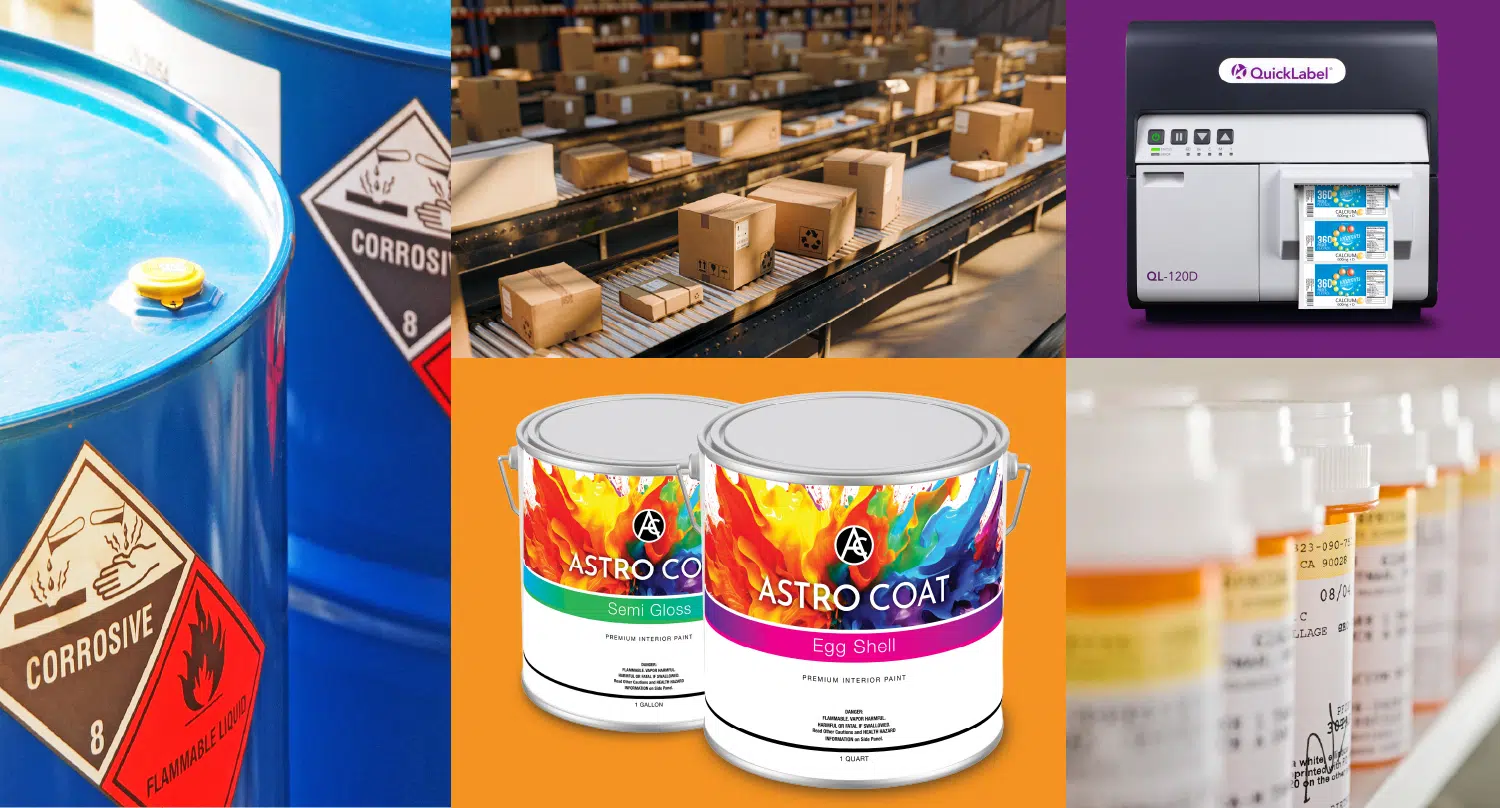
Labeling in adhesives and coatings manufacturing presents ongoing operational challenges due to GHS compliance requirements, frequent formulation changes, and harsh chemical environments. In practice, labeling rarely remains the same for long. Formulations evolve, hazard classifications are updated, and customer requirements shift. Demands for labeling changes often outpace traditional labeling processes. At the same time, labels must withstand exposure to chemicals, handling, and environmental conditions without losing legibility.
All this creates steady operational pressure. In high-mix environments with short runs and frequent updates, pre-printed labels can quickly become outdated, resulting in delays, excess inventory, and unnecessary waste.
In-house label printing offers a more adaptable approach. By producing labels on demand and aligning labeling directly with production, manufacturers can respond more quickly to change while maintaining durability, accuracy, and compliance.
What makes chemical labeling in adhesives and coatings complex?
Labeling sits at the intersection of compliance, durability, and operational variability. Products must meet GHS requirements and remain legible after exposure to chemicals, abrasion, and routine handling.
Complicating matters further, label content is rarely static. Hazard classifications may change, formulations are updated, and customer or regional requirements can introduce new variations. Labels must reflect these changes quickly without compromising accuracy or traceability.
Operational Drivers of Label Complexity in Chemical Manufacturing
Labeling is closely tied to product variability. For adhesives and coatings manufacturers, changes in formulation, updates to hazard classifications, and customer-specific requirements all contribute to a steady flow of revisions.
Packaging teams are responsible for managing:
- Hazard statements and GHS pictograms
- Batch, lot, and date-specific information
- Customer and private-label variations
- Regional regulatory differences
Labeling errors or degradation can have serious consequences. Unreadable or incorrect labels can lead to failed audits, rejected shipments, or safety concerns during handling. But even when these issues are caught internally before shipment, the required relabeling and rework result in additional labor and cost.
High-Mix Environments Increase Labeling Pressure
In the high-mix production environment of adhesives and coatings manufacturing, labeling requirements shift frequently across products, batches, and customers. Packaging teams may rapidly transition between formulations, packaging configurations, and regulatory requirements. These factors often introduce complex operational challenges that are less common in large-scale commercial manufacturing. They include:
- Frequent formulation and hazard classification changes
- Multiple label versions across product lines and customers
- Low production volumes that reduce the efficiency of pre-printed inventory
- Tight production and shipping timelines
When labels are pre-printed and inventoried, even small changes can render existing inventory unusable, leading to waste, delays, and unnecessary costs.
Digital Printing Enables Responsive Chemical Labeling
In-house digital printing changes everything.
In-house digital printers, such as the QL-120D and pigment-based QL-435, enable manufacturers to produce labels on demand rather than estimate demand in advance. Updates to hazard information, batch data, or branding can be made immediately, without waiting on external suppliers. This flexibility has practical benefits:
- Label content can be updated without interrupting production
- Minimum order constraints are no longer a factor
- Obsolete inventory is reduced or eliminated
- Small batches, pilot runs, and private-label products become easier to manage
The result: Rather than working around labeling constraints, teams can align labeling directly with production.
Why Pigment Ink Matters in Chemical Environments
In many adhesives and coatings applications, label durability is tested almost immediately. Containers are handled, stacked, and transported. Surfaces may be exposed to solvents, oils, or moisture. In these conditions, conventional printing methods might fail to maintain legibility.
Pigment-based printing, as used in the QL-435, provides a more durable alternative. Because the ink sits on the label’s surface rather than being absorbed, it is less likely to smear or degrade when exposed to chemicals or during handling. This is a key advantage when:
- Containers are handled with solvent-contaminated gloves
- Labels come into contact with product residue
- Drums and pails are stored in bright or variable environments
Maintaining readable text, hazard warnings, and barcodes is essential not only for compliance but for day-to-day usability.
Materials Must Withstand Chemical Exposure and Handling
Even the best print technology depends on the right material.
Adhesives and coatings products are typically packaged in metal drums, HDPE pails, and other containers that present challenges for label adhesion. Surfaces may be curved, slightly contaminated, or subject to temperature changes.
Durable label materials are designed to handle these conditions by:
- Adhering reliably to curved or difficult surfaces
- Resisting chemical exposure and abrasion
- Maintaining integrity through storage and transport
When paired with the appropriate printing technology, the use of the correct materials helps ensure that labels remain intact and legible throughout the product lifecycle.
Software-Driven Control and Traceability
As labeling complexity increases, so does the need for control. Labeling software plays a central role in managing variable data and maintaining consistency across production. It enables labeling to incorporate:
- Lot numbers and batch identifiers
- Manufacture and expiration dates
- Barcodes or QR codes for tracking
Such information supports traceability from production through distribution. In the event of a quality issue or recall, accurate labeling data enables manufacturers to quickly identify affected products and respond. In regulated environments, it also helps to reinforce audit readiness while reducing reliance on manual data entry.
Managing Labeling Workflows Across Production and Distribution
Labeling extends beyond the primary container to include secondary packaging, case markings, and shipping identification. Managing this effectively requires systems that scale without adding complexity.
Direct-to-package printing technologies, such as the AstroJet AJ-200, print directly onto cartons and outer packaging, reducing the need for separate labels and eliminating additional application steps. In higher-volume production, direct-to-package printing can:
- Reduce label inventory requirements
- Streamline packaging operations
- Improve efficiency in marking cases and pallets
When primary and secondary labeling are aligned, the overall production process is more consistent and easier to manage.
Conclusion
Labeling in adhesives and coatings manufacturing sits at the intersection of compliance, durability, and operational flexibility. Requirements change frequently, and the environments labels must endure are often unforgiving.
In-house label printing provides a practical way to manage these challenges. By enabling on-demand production, supporting durable label performance, and improving control over data and workflows, manufacturers can keep pace with changing requirements—without sacrificing accuracy or efficiency.
Key Takeaways
- Label requirements in adhesives and coatings environments change frequently
- GHS compliance depends on labels remaining accurate and legible throughout use
- Chemical exposure and handling can degrade labels and create compliance risks
- In-house label printing supports faster updates and reduces wasted pre-printed inventory
- Pigment-based printing and durable materials improve label performance
- Labeling software is key to supporting traceability and audit readiness
Frequently Asked Questions About Chemical Labeling
- What is GHS compliance in labeling?
GHS compliance refers to adherence to the Globally Harmonized System for the Classification and Labeling of Chemicals. Labels must include standardized hazard information, pictograms, and safety statements to support safe handling, regulatory compliance, and consistent communication across regions. - Why are durable labels important in adhesives and coatings manufacturing?
Durable labels ensure that hazard warnings, product information, and traceability data remain legible despite exposure to chemicals, abrasion, and handling. Maintaining label integrity is essential for compliance and day-to-day usability. - How does in-house label printing improve operations?
In-house label printing allows manufacturers to produce labels on demand. This reduces delays, eliminates excess inventory, and enables faster updating when formulations, hazard classifications, or customer requirements change. - What role does pigment-based printing play in label durability?
Pigment-based printing improves resistance to smudging, chemical exposure, and environmental conditions. Because the ink sits on the surface of the label, it is less likely to degrade when exposed to solvents, oils, or handling. - When is direct-to-package printing useful?
Direct-to-package printing is well-suited for secondary packaging such as cartons, cases, and pallet markings. It can reduce label inventory, eliminate production steps, and streamline packaging workflows in high-volume environments.
